Login | Become a member
NAPA VALLEY GRAPEGROWERS
  • About Us
    • 50th Anniversary
    • Mission & History
    • Board of Directors
    • Our Team
    • Grower of the Year >
      • About the Grower of the Year Award
    • Lifetime Achievement Award
    • Sponsorship
    • In the News
    • Contact Us
  • Viticulture
    • Growing Season
    • Pests & Diseases
    • Soil Health >
      • Cover Crops
      • Compost
    • Vineyard Development
    • Water & Irrigation >
      • Groundwater Sustainability Plan
  • Environment
    • Air Quality >
      • Agricultural Burning
    • Ag Preserve >
      • Conservation Landscape
    • Climate Resilience >
      • Climate Video Series
      • Modern vs. Fossil CO2
      • Reduce Climate Impact
    • Wildfires
  • Resources
    • Best Practices
    • Directory
    • Grower Resources >
      • Crop Insurance
      • Financial Model
      • Tools for Grape Sales
      • Weather Alert
    • Industry Blog
    • Napa Winegrape Market
    • Podcast
    • Reports & Research >
      • Grape Crush Report
      • Napa County Crop Report
      • Growing Conditions Report
      • Soil Health Report
  • Networking
    • Calendar
    • Paso Adelante
    • Harvest STOMP®
    • ROOTSTOCK
  • Members
    • Member Portal
    • How to Join >
      • Growers
      • Vineyard Management Companies
      • Associates
  • Community
    • FOG Blog
    • FAQs
  • Donate
    • Our Donors
    • Your Impact
    • Ways to Give
    • Sip and Support Program
  • About Us
    • 50th Anniversary
    • Mission & History
    • Board of Directors
    • Our Team
    • Grower of the Year >
      • About the Grower of the Year Award
    • Lifetime Achievement Award
    • Sponsorship
    • In the News
    • Contact Us
  • Viticulture
    • Growing Season
    • Pests & Diseases
    • Soil Health >
      • Cover Crops
      • Compost
    • Vineyard Development
    • Water & Irrigation >
      • Groundwater Sustainability Plan
  • Environment
    • Air Quality >
      • Agricultural Burning
    • Ag Preserve >
      • Conservation Landscape
    • Climate Resilience >
      • Climate Video Series
      • Modern vs. Fossil CO2
      • Reduce Climate Impact
    • Wildfires
  • Resources
    • Best Practices
    • Directory
    • Grower Resources >
      • Crop Insurance
      • Financial Model
      • Tools for Grape Sales
      • Weather Alert
    • Industry Blog
    • Napa Winegrape Market
    • Podcast
    • Reports & Research >
      • Grape Crush Report
      • Napa County Crop Report
      • Growing Conditions Report
      • Soil Health Report
  • Networking
    • Calendar
    • Paso Adelante
    • Harvest STOMP®
    • ROOTSTOCK
  • Members
    • Member Portal
    • How to Join >
      • Growers
      • Vineyard Management Companies
      • Associates
  • Community
    • FOG Blog
    • FAQs
  • Donate
    • Our Donors
    • Your Impact
    • Ways to Give
    • Sip and Support Program

Education for Hospitality

Across Napa Valley, hospitality teams have an important task - to answer questions and educate tasting room visitors about the vineyard! To help your teams respond confidently, the Napa Valley Grapegrowers hosts Seasonal Vineyard Walks for hospitality professionals, a complimentary educational experience on seasonal and sustainable vineyard practices.
Paraduxx: Integrative Pest Management

Cultural Practices

Cover Crop
In order to enhance biological control its important to establish habitat for predator and parasitoids. Flowering plants provide nectar and pollen, which some adult predators like lacewings need to consume. Some common insectary plants include California Poppy, Lacy Leafed Phacelia, Carrot, Alyssum, and Clovers. Native vegetation between vine rows and avenues can also provide habitat for beneficial insects. No-till or alternate tillage systems are utilized to increase biodiversity and reduce dust in a vineyard.  

Common Pests in the Vineyard

Picture
Mealybugs
Mealybugs
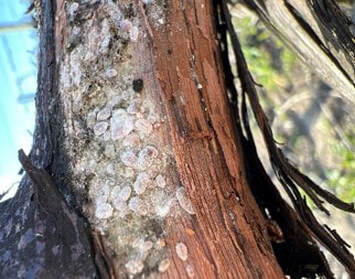
Mealybugs are soft and oval, have a white waxy covering, and are roughly a ¼” long. Mealybugs appear on trunks and cordons in the spring. As temperatures warm in summer, they can be found on all parts of the vine including leaves and clusters. Ants and mealybugs are known to have a symbiotic relationship. Ants will protect and fend off predators, as mealybugs excrete honeydew.
Picture
Leafhoppers
Leafhoppers
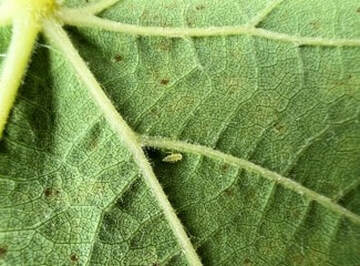
Nymphs and adult leafhoppers feed on leaves removing the contents of leaf cells. When populations are high the entire leaf may become pale yellow or white. Leaf-drop may occur, resulting in delayed ripening and sunburn to fruit.  
Spider Mites
Spider mites damage grape leaves by puncturing cells and sucking out their contents. In heavy infestations damaged leaves will turn yellow or red (red varieties).

Beneficial Insects

Picture
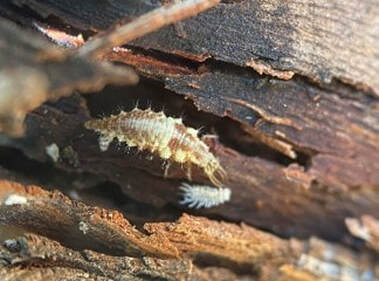
Lacewing (Chrysoperla spp.)
Lacewing (Chrysoperla spp.) are generalist predators, meaning they target a broad spectrum of small insects and mites. In grapes,  lacewing can be used to combat mites, mealybugs, leafhoppers, whiteflies, and caterpillars. All lacewing larvae are predaceous, but adults of lacewings are not predaceous and feed on nectar and pollen. Larvae of the lacewing attack prey and suck their bodily fluids.
Picture
Anagyrus pseudococci
Anagyrus pseudococci is a parasitic wasp that attacks the third and fourth instar of vine mealybugs and can play a major role in controlling mealybug in grape. Effective ant control must be implemented to have successful establishment.
Mealybug destroyer Cryptolaemus montrouzieri can be used to control mealybug in grapes. Larvae mimic mealybugs in appearance and odor, which allow them to feast on their prey with little disturbance from protective ants. Females can lay up to 400 eggs in “Hot Spots.” Young larvae prefer eggs and early instar mealybugs, while older larvae and adults feed on all stages of the mealybug. They can consume 30 to 70 mealybugs per day.

Scouting

When scouting a ranch, it is important to look for both macro and micro issues. This means reporting a broken irrigation valve as well as tracking mite activity - you're essentially becoming the eyes and ears of the vineyard team. The reports of a scout directly impact the decision making of the viticulture and vineyard operations teams.

The following are general scouting instructions:
Overall Vineyard Observations: anything broken, missing signage, gate/fence problems, excessive vertebrate problems
 
Entomological
  • Mites: Count population per leaf as well as frequency of mite appearance per 10-15 leaves. Start by looking in the basal area of canopy and then to mid then high canopy.
  • Leafhoppers: Nymph counts (Frequency Vs Population) - damage is defined as stippling of leaves
  • Thrips: in shoot tips (during active growth) and clusters during bloom - causes halo pattern scarring
  • Beneficial presence: Yes/No    +    Low, Moderate, High
Note: Mite/ leafhopper foliage damage, as well as, how heavy damage and high/medium/low in canopy, as well as intensity throughout block or row
 
Weeds
Name/Species as well as frequency - high/medium/low. It is also helpful to have growth stage if possible. Since many people are moving away from systemic herbicides it has become more important to treat weeds when they're young or to mow/disc vineyard at an early stage of growth. Some weeds such as Queen Ann’s Lace can grow up into the fruit zone and can cause off flavors in wine.
 
Berry Appearance
Growth stage/ Sunburn/ thrip damage/ uneven ripening/ excessive tangling and bunching/ powdery mildew/ bunch stem necrosis or any unusual berry appearance
 
Virus/ Mold/ Rots/Mildew
These tend to be the most impactful things we scout for besides insect pests. Mildews and molds especially can spread very fast and once they have taken over they are hard to get rid of. Although mold, like botrytis, can be valued for the making of some wines, most molds/viruses and mildews can have adverse effects on wine quality.
  • Where/ when/ how aggressive (aka frequency)/ dead or alive/ damage?
  • Powdery Mildew/Downey Mildew: On leaves and/or fruit? How many clusters are infected?
  • Botrytis/Green mold: How widespread? Appearance?
  • Viruses: Pierce’s Disease/ Leafroll/ Red Blotch and more

Water/ Vine Stress

Shoot Tip termination stages:
  • Stage 1: Long tendrils grown past shoot tip
  • Stage 2: Tendrils equal to shoot tip
  • Stage 3: Dead tendrils or no tendrils
Rate of shoot growth slows and the shoot tips gradually become more grayish green, like the mature leaves. Tendril drying and abscission is also a useful early indicator of vine water stress. As water stress continues, leaves appear wilted, particularly during midday heat. Under prolonged and severe stress, leaves curl, brown, and eventually drop.
 
Nutrient:
Diagnosing nutrient deficiencies or excess can be very difficult without a tissue analysis done in the lab. A vine can be deficient in more than one nutrient or can have a toxicity plus a deficiency. Usually taken during 50% bloom or sometimes at 50% veraison, most farming companies take leaf blade or petiole analysis at least one to two times a growing season. The results help growers indicate which foliar nutrients or injected nutrients to apply. Lacking in nutrients can significantly and negatively affect fruit or canopy during the most key time of the year...harvest.

​When a scout reports they look in the canopy high/mid/low as well as reporting on frequency or if it is just single vine or pattern… basal or meristem (bottom of canopy or shoot tip) – pictures are good for reporting because it is important to stay as objective as possible.
RENTERIA 360: ​Harvest and winterization

Harvest Season in Napa Valley

Picture
Picture
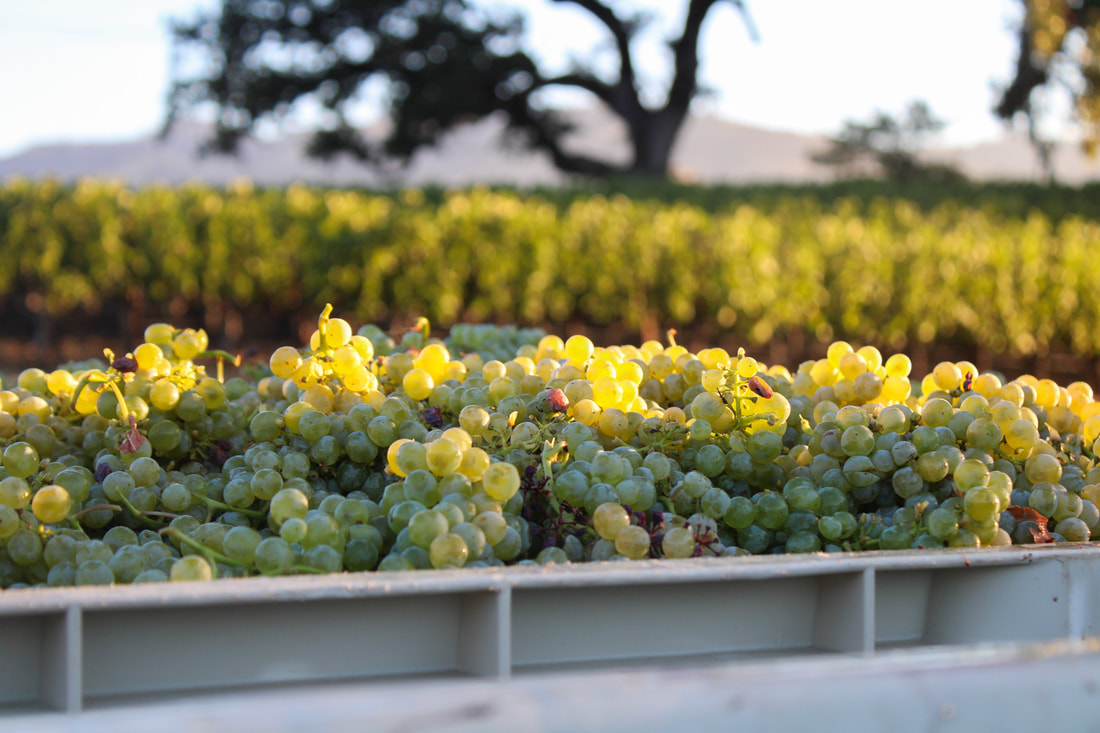
As we near the conclusion of what has been a relatively cool growing season here in the Napa Valley, growers and winemakers alike have all been reveling in the amazing quality of this bountiful harvest. In an industry where we are continually driven and dictated by Mother Nature and what we can and cannot do, this is a vintage of terroir, where the site and grapes themselves have been able to fully express themselves to their full potential.
 
In grape growing, it’s fundamental to fully understand the natural composition of the vineyard terroir, the complete natural environment in which a particular wine is grown and produced…the soil, topography and climate. With this intimate knowledge of the site, growers can act and react according to what is required and needed of the vines through various vineyard activities. Everything we do in the vineyard has a direct and indirect reaction to the final product that ends up in your glass.
 
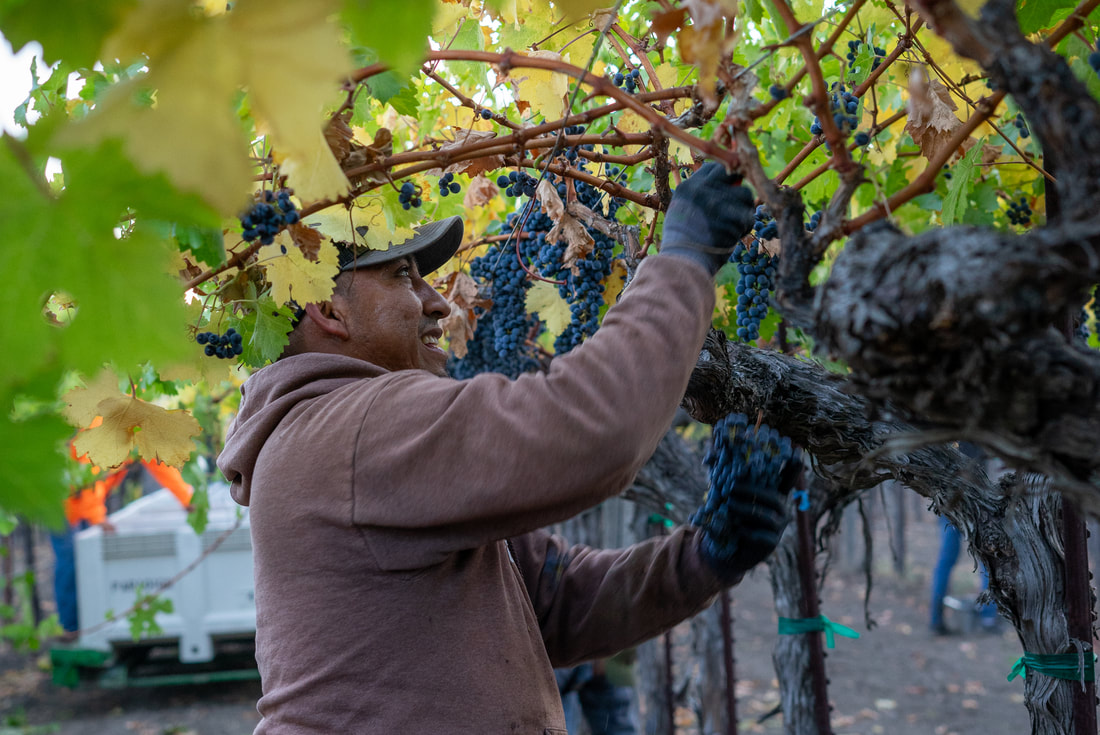
Harvest is the most intimate, critical, and magical time in grape growing, and especially here in Napa Valley. This is what we call the big dance. The time of year that we have all been awaiting and working towards with much patience and anticipation. The harvesting of grapes for wine production, is the one time of the year where everyone – from the vineyard and winery - comes together to achieve the same goal: to deliver and bring in the utmost quality fruit possible.
​

Harvest Best Practices

​Preparation
A key to a successful harvest is preparation. Before harvest even begins, growers service all equipment to prevent any delays during harvest, which can become costly and compromise the grape quality by having it sit out in rising morning temperatures. Understanding the estimated crop load being brought in directly relates to labor needs, number of bins, machinery and transportation, delivery tags, and processing at the winery. Winemakers in the same way, review all of their crush equipment, preparing in any way possible to ensure they can process the delivered fruit without any issues.
 
Optimal Conditions
This is the time where the partnership and relationship between a grower and a winemaker is the most critical. Winemakers always make the final decision for when the fruit is tasting in its ultimate prime quality to produce the best wine possible. Once this “call” is made, it is up to the growers to aid the winemakers and create a harvest plan, to schedule when the fruit will be picked, transported, and the wineries then to schedule when they process the fruit. Fruit here in Napa Valley is typically harvested at night or early morning when temperatures are cool, and fruit is at a stable brix level. Forecasted weather also influences the when picks are scheduled.
 
Safety
Since picks take place without much natural light, vineyard managers make safety a priority for the crews harvesting, tractor drivers and truck drivers who haul the fruit. A detailed explanation of the intended harvest logistics is very important – allowing for a flow and a collective understanding from everyone involved. Vineyard managers also pay special attention to work -load and prevention of fatigue. Many crews work consecutive mornings in a role that requires strength and precision.
 
Glossary of Key Harvest Metrics
 
Brix
This is a measurement of the sugar content of grapes, must and wine, indicating the degree of the grapes' ripeness (meaning sugar level) at harvest. This is measured by utilizing a refractometer, either in the winery lab or in the field. Most still wine grapes are harvested at between 21 and 27 Brix, depending on the variety. Winemakers and Enologists alike, utilize this number to get an alcohol conversion level, by multiplying the stated Brix by .55.
 
pH
A chemical measurement of acidity or alkalinity; the higher the pH the weaker the acid. Used by some growers and wineries as a measurement of ripeness in relation to acidity. Low pH wines taste tart and crisp; higher pH wines are more susceptible to bacterial growth. On average, a range of 3.0 to 3.4 is desirable for white wines, while 3.3 to 3.6 is best for reds.
 
TA
The principal acid in grapes and wine; contributes to taste and stabilizes color. Unlike malic acid, tartaric acid does not decline as grapes ripen. Tartaric acid can precipitate out of solution in bottled wine to form harmless tartrate crystals resembling shards of glass.
LARKMEAD: PRUNING

The Importance of Pruning

Picture
Picture
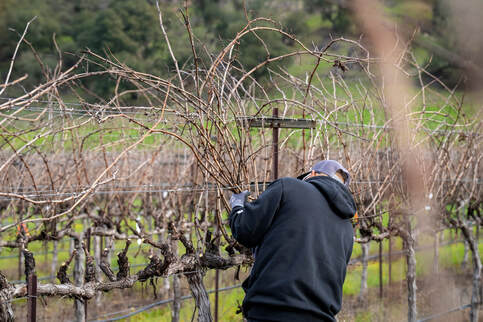
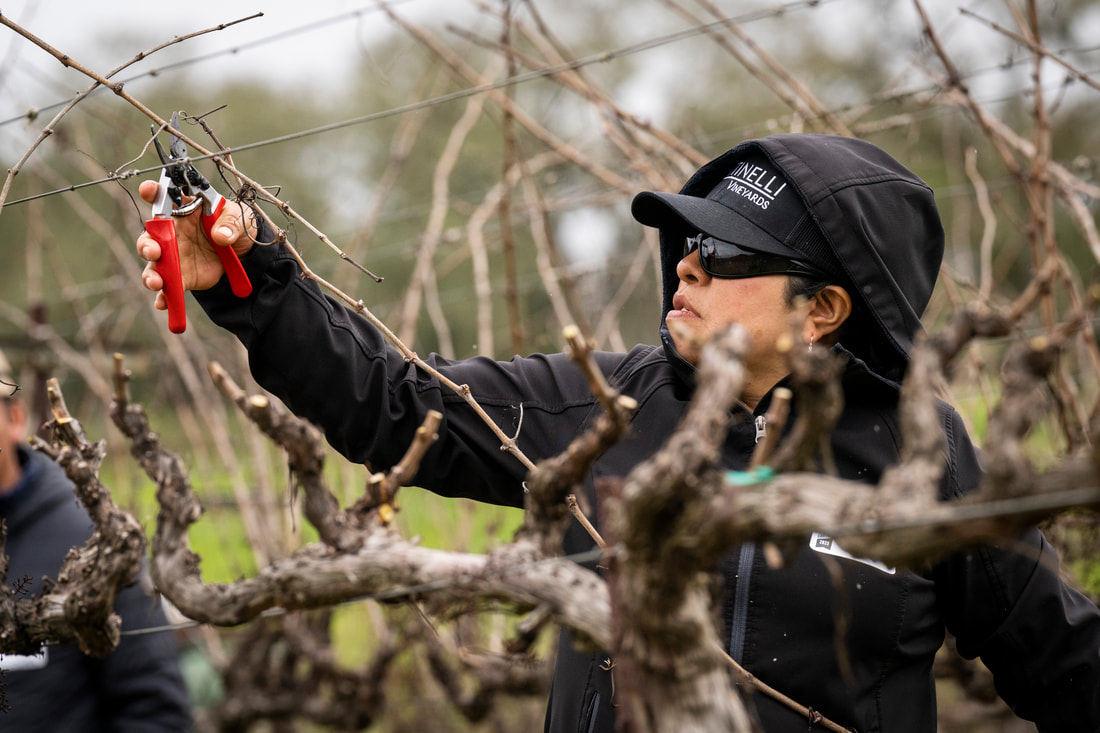
Considered one of the most important activities in the vineyard, pruning is done to create vine balance, influencing grape yields and fruit quality. When pruning, 70 to 90 percent of the previous year's growth is removed and select cane or spur positions are left.  From the remaining buds on the vine, budbreak takes place, resulting in new growth and the start of the 120-day growing season.

Growers’ pruning strategies slightly change every year, influenced by the past growing season, current vine health, and desired fruit quality. Viticulturists and vineyard managers set the standards and then convey them to the team in a pruning planning meeting to ensure uniform application. Growers tend to prune late in the season to delay budbreak and avoid disease exposure.

Pruning is done with speed and precision. Once the vine is assessed and the position is selected, the removal of last year’s growth takes place. Clean cuts near, but not too close to, the bud is needed. For cane pruning, canes are carefully tied to the wire with tape. Good ties ensure the vine’s sap flow and ability to grow.

Pruning requires a high skill level and ideally an in-depth knowledge of the vineyard site, “Well-pruned vines, through the wisdom and knowledge of a great vineyard crew, balance what they can produce with what a site can provide, creating the best possible fruit from each vineyard.”

So, while pruning and tying down the canes may not be as social media-worthy as ripening fruit clusters, it’s easily the most important part of maintaining vineyard health and producing great wine.
​

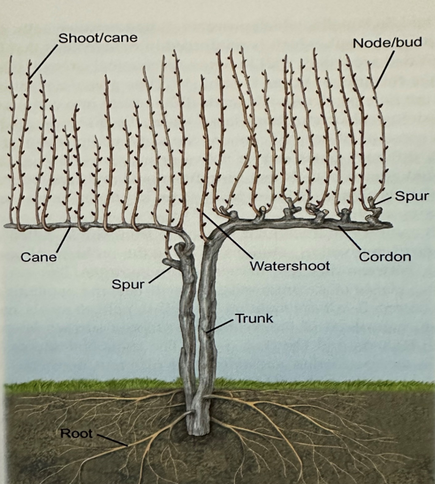
Pruning Diagram

Picture

Pruning Preparation

Once harvest is complete and winter erosion control measures are put into place, growers embark on vine assessments, which directly influence the pruning standards applied between January and early March. Counting the number of canes per vine and calculating the average cane weight is also used to measure vigor. These activities include:
 
Pruning Weights
Collected throughout the vineyard site – usually multiple sets of 5 consecutive obtained from different areas of vigor within the block – pruning weights are obtained by measuring the weight of cut canes and dividing it by the number of linear feet of the canopy per vine. These measurements indicate vine vigor and overall health.

Mapping
Mapping the pruning weight data gives growers an accurate vineyard site overview. The ability to pinpoint details such as, vine vigor, irregularity, and measurables around vineyard management practices helps to prepare for pruning and the growing season ahead. Complete data assessment provides the road map needed to maintain a healthy, sustainable vineyard for the long term.

Wine Quality
​
Growers taste barrel samples from last year’s vintage with winemaking teams to further understand the grape quality. Collectively, they single out high quality blocks verses those that are not fully expressed and need additional support.
​

Pruning Best Practices

Safety
Pruning takes place in late winter or early spring when vineyard rows are often muddy. Protective gear such as rainboots, leather gloves and eyewear prevent injury.  Some growers pre-prune their vines, by hand or machine, to mitigate safety risks and allow for precision cuts at pruning.
​
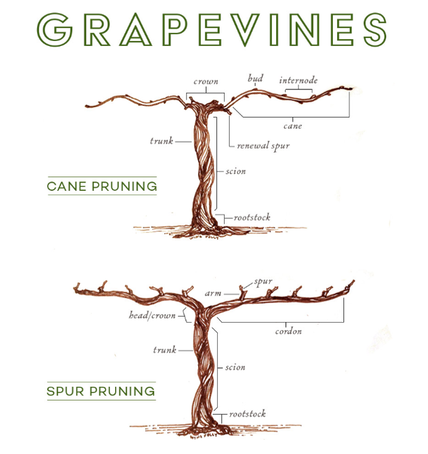
Spur vs. Cane Pruning​
Picture
Spur-pruned vines have the look you might expect from grapevines. They are cordon-trained; all the wood that makes up the cordon is old wood that has been built over the years. Those horizontal arms are called cordons.
​
Cane-pruned vines consist of a vine trunk and head, lacking a cordon on either side. Instead, two canes shoot from the previous year's growth are left during pruning and laid down on training wire. New growth comes from the buds on those canes. Those one-year-old canes are completely removed, and new, fresh canes grow in their place.  

Past Seasonal Vineyard Walks

Trade Resources: Speakers | Press | Sponsors
​
Copyright Napa Valley Grapegrowers.  All Rights Reserved.

831 Latour Court, Suite A  |  Napa, CA 94558
Phone: (707) 944-8311 | [email protected]
Privacy Policy | Sitemap | All header images © Sarah Anne Risk
Napa Valley Grapegrowers is a 501(c)3 public charity. Our federal tax ID number is # 82-2012860

Sign-up for our community newsletter

​Subscribe to Friends of the Grapegrowers (FOG) to receive exclusive updates, educational workshops, vineyard tours, special events, and a quarterly newsletter with insights into Napa Valley grape-growing, sustainability, climate initiatives, and the latest trends in viticulture.
Subscribe
Picture
Picture
Picture
Strategic Partner